
What is the market sentiment definition? Learn how to read the market’s hidden signals and join the elite traders who profit from shifting crowd psychology.
Forecasting trends with market sentiment can be highly rewarding for almost every trading style. However, only a fraction of technical analysts boast significant success on attempted trials.
Continue reading this article to dive deeper into investor sentiment and trend trading with actionable tips. It also promises a revolutionary indicator to streamline this analysis impressively for improved results.
The market sentiment definition refers to the collective attitude or mood of investors and traders toward a specific financial asset. It is a cumulation of individual outlooks at a particular period, which defines price moves.
A practical market sentiment definition involves classifying the “mood” of the market as either bullish or bearish. While bullish sentiment drives rising prices, bearish sentiment prevails when they fall.
Trend traders use this market sentiment definition to exploit sustained price moves using tools like:
Moving Averages (MAs): The simplest way to reveal investor outlook.
The Bullish Percent Index (BPI)
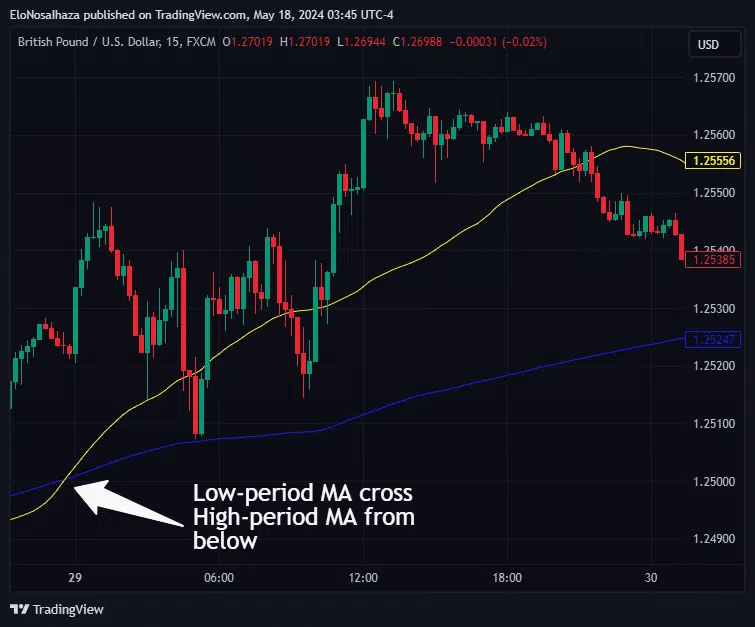
When a shorter-period MA crosses above a longer-period one, it signals a bullish shift. Conversely, a cross below indicates a bearish market sentiment definition in action.
Emotions, especially fear and greed, are most responsible for market sentiment. They may arise after analyses of various real-world factors.
Common information sources include the news and social media, which can be false. Hence, trend traders must approach the markets cautiously to avoid being caught on the wrong side.
Trend trading is one of the safest practices for new and experienced traders. Once on the right side of the market, one’s profit can compound for as long as a trend persists.
However, when achieved with investor sentiment, below are a few facts to remember for the best results:
As discussed, traders assess investor sentiment through various means, including the news, finance websites, and social media. Any of these information sources may be misleading.
A practical solution is to filter such mediums to concentrate on the most trusted options.
Seasoned traders can assist with this.
Sentiment analysis is most common among scalpers and day traders. Nevertheless, others exploit it for trend trading on higher time frames.
It is essential to distinguish this factor whenever analyzing investor mood.
A bearish sentiment can quickly change for a bullish one on the same market at any time, short- or long-term.
Novices may misinterpret sentiment analysis as a fundamental process because significant effort is away from the charts. Contrarily, this is far from the case.
Fundamental analysis studies real-world factors that influence an asset’s performance, but sentiment examinations only deal with investors’ consensual feelings.
It is also not a technical analysis procedure for the same reason.
Solely relying on investor sentiment is not the best approach to trend trading. Top analysts turn to more basic and sophisticated tools (fundamental/technical) for improved market insight.
It is always more fruitful to consider the bigger picture.
An indicator used to measure market sentiment may pose several possible setbacks unique to its nature.
For example, traders can set different types of Moving Averages for various periods, depending on the one’s nature of analysis. Failure to do this correctly may yield unnoticed lags.
Successful forecasting with market sentiment can be challenging not only due to lack of experience but for several independent factors that decrease precision.
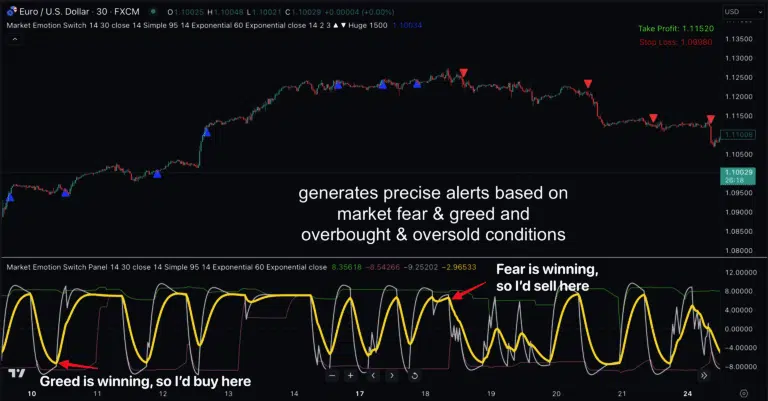
Fortunately, Indicator Vault has pioneered a ground-breaking solution – The Market Emotion Switch Indicator for TradingView.
Unlike regular sentiment indicators, this powerful tool identifies overbought/oversold conditions and reveals the best trade entry points.
The following are some benefits it offers users:
Sounds unreal? Confirm it here now and bolster your performance.
By mastering the market sentiment definition, trend traders can accurately forecast market direction based on the prevailing investor mood. This sentiment is typically classified as either bullish or bearish and can be uncovered using several technical methods.
One of the most recommended ways involves utilizing The Market Emotion Switch Indicator. It combines different theories in its algorithm for a nearly automated practice.
Please share this article among trading enthusiasts and leave concerns, suggestions, and results in the Comment Section for insightful discussions.