Understanding order block concepts can significantly improve how you read price action and identify high-probability trade setups.
Instead of relying on lagging indicators, many professional traders focus on areas where institutional money enters the market. These areas known as order blocks often explain why price reverses, consolidates, or accelerates.
In this guide, you’ll learn what order blocks are, how bullish order blocks and bearish order blocks work, and how to apply them in a structured trading strategy.
Table of Contents
1. What is an order block in trading?
An order block is a price zone where institutional traders place significant buy or sell orders. These zones often leave a visible “footprint” on the chart, which retail traders can use to anticipate future price movements.
Unlike traditional support and resistance, order blocks are based on actual order flow and liquidity, making them more aligned with how the market truly operates.
Price tends to revisit these zones because unfilled institutional orders remain there. When price returns, it often reacts strongly, leading to continuation or reversal moves.
2. Types of order blocks in trading
Understanding the difference between a bullish order block and a bearish order block is essential for applying this concept correctly.
2.1. Bullish order block
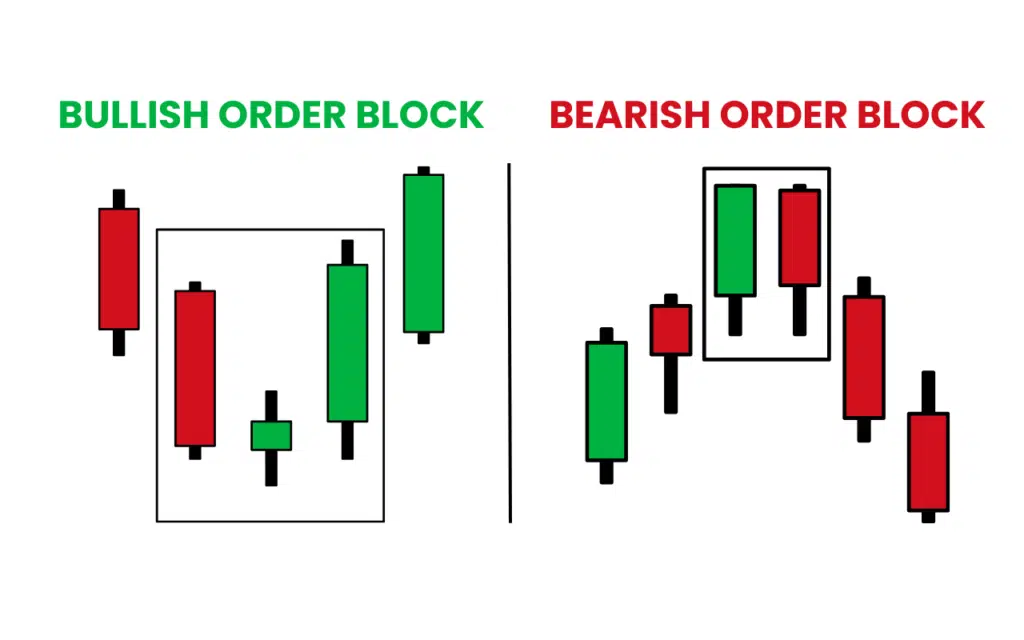
A bullish order block forms when strong buying activity enters the market after a down move. This zone represents accumulation by institutions.
When price revisits a bullish order block, it often finds support and moves upward again. Traders typically look for buying opportunities in these areas, especially when aligned with an overall uptrend.
2.2. Bearish order block
A bearish order block forms when strong selling pressure appears after an upward move. This indicates distribution by large players.
When price returns to a bearish order block, it often acts as resistance, pushing price downward. These zones are commonly used to identify short-selling opportunities.
3. How to trade using order blocks
The effectiveness of the order block concept comes from market mechanics rather than theory.
Institutional traders cannot execute large orders in a single transaction without moving the market significantly. Instead, they build positions over time, creating zones where liquidity is concentrated.
These zones tend to:
- Attract price back (liquidity seeking behavior)
- Trigger strong reactions upon retest
- Act as decision points for market direction
This is why order blocks often behave like price magnets followed by sharp reversals.
Applying order blocks in a trading strategy requires more than just identifying zones. The key is understanding how price behaves when it returns to these levels.
A common approach is to wait for price to revisit a previously identified order block and look for confirmation signals such as rejection wicks, strong momentum shifts, or structure breaks.
Entries are typically placed near the zones, allowing for tighter stop losses. Stop loss levels are often positioned just beyond the order block, while profit targets can be set based on previous highs or lows, or risk-reward ratios.
Order blocks can be used in both trending and ranging markets, but they are particularly effective when aligned with the broader market direction.
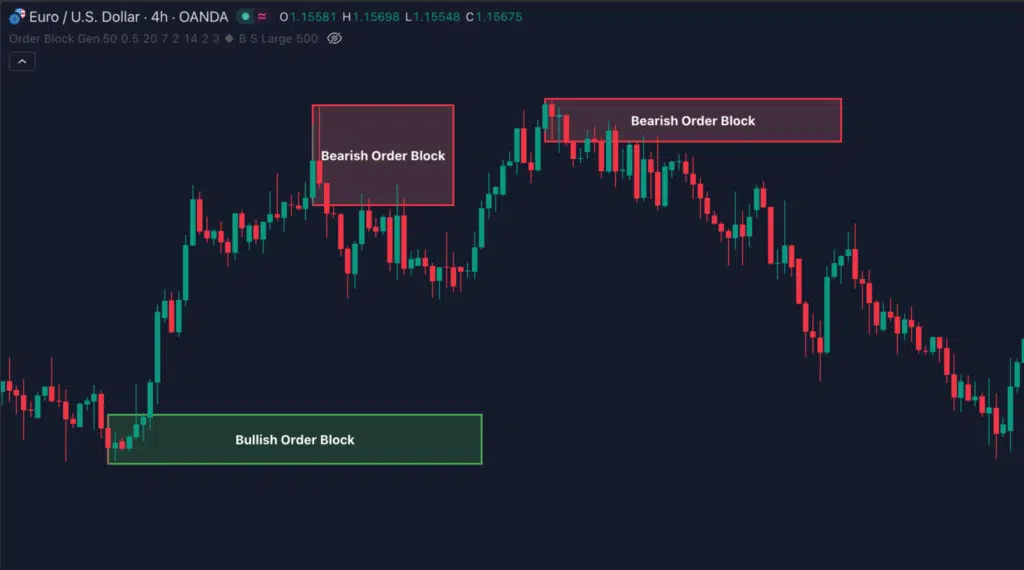
One of the main advantages of using bullish and bearish order blocks is the ability to identify precise entry and exit points. This improves risk management and allows traders to achieve better risk-to-reward ratios.
Another benefit is early entry. Since order blocks often mark the origin of strong moves, traders can position themselves before the majority of the market reacts.
However, the biggest limitation is accuracy in identifying valid order blocks. Manually marking these zones requires experience and can be subjective, especially for beginners. This is where automation becomes valuable.
4. Simplifying order block analysis with the Order Block Gen indicator
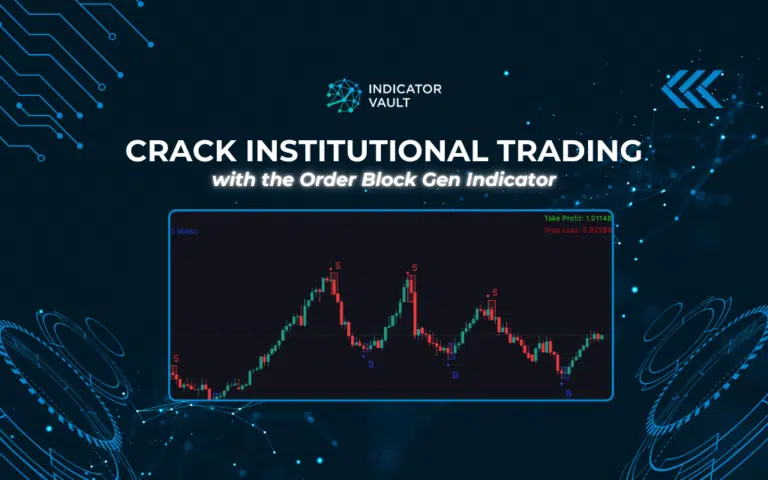
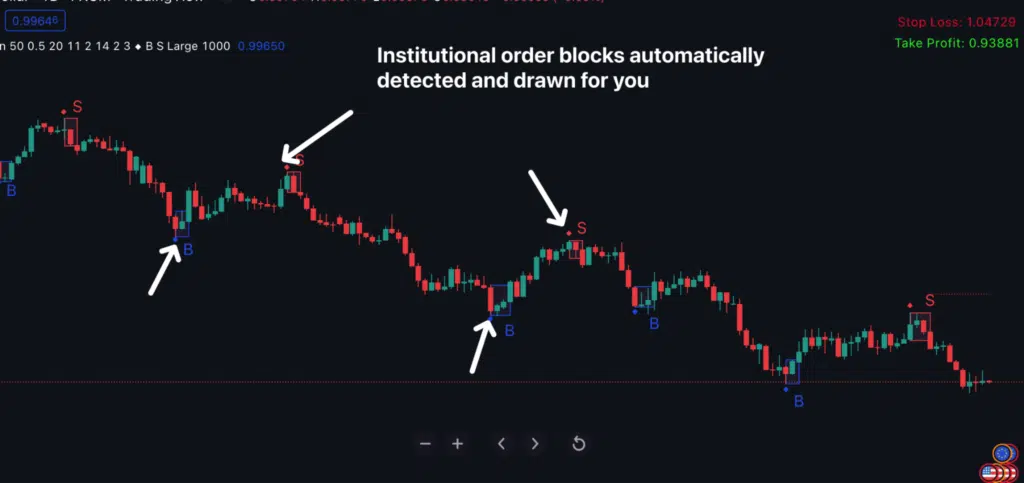
Order Block Gen for TradingView is designed to eliminate the complexity of manually identifying order blocks. This indicator manually scans the market and highlights both bullish order blocks and bearish order blocks in real time. This allows traders to focus on execution rather than analysis.
4.1. How the indicator works
Order Block Gen detects institutional activity by analyzing price structure and order flow patterns. Once a valid order block is identified, it is displayed directly on the chart as a key zone.
This gives traders immediate visibility into potential reversal areas across multiple timeframes and currency pairs.
4.2. Key benefits for traders
The main strength of the tool lies in its ability to provide structured, actionable insights. It helps traders:
- Identify high-probability reversal zones
- Avoid false breakouts and weak setups
- Align trades with institutional activity
- Maintain consistent risk management with suggested stop loss and take profit levels
Real-time alerts ensure that traders do not miss important setups, making it suitable for both intraday and swing trading.
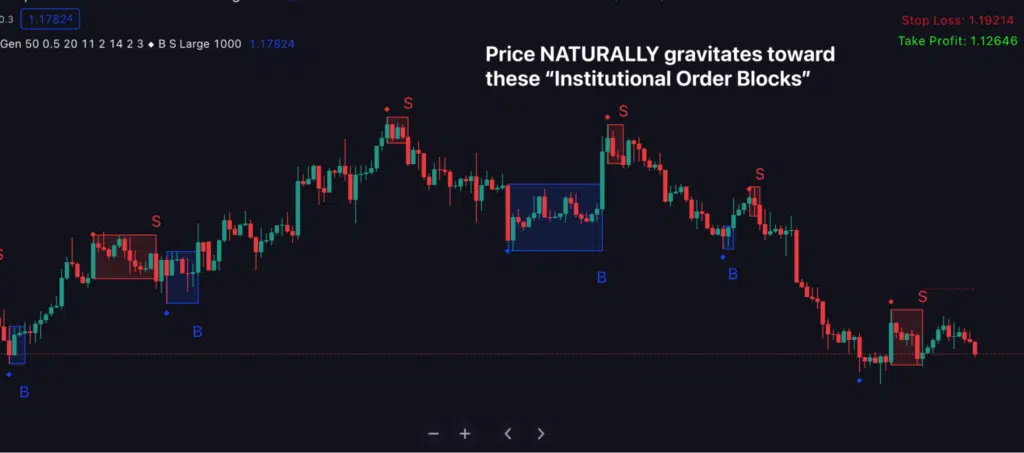
The order block strategy is versatile and can be applied across different trading styles. Day traders benefit from precise intraday entries, while swing traders can use higher timeframe order blocks to capture larger market moves. Scalpers can also apply the concept on lower timeframes to identify quick reversal opportunities.
More importantly, this approach is suitable for traders who want to move beyond basic indicators and understand how price behaves at key institutional levels.
So if you want to improve your strategy, let’s take a look at the Order Block Gen first
5. Final thoughts
Mastering the order block concept gives traders a clearer view of how the market operates behind the scenes.
By understanding the behavior of bullish order blocks and bearish order blocks, you can identify where price is likely to react and plan trades with greater precision.
While manual analysis can be challenging, tools like Order Block Gen for TradingView make it easier to apply this strategy consistently. With a structured approach and the right tools, order block trading becomes a powerful method for identifying high-probability setups in the forex market.