If you’ve been trading for any length of time, you already know the MACD indicator. It’s one of the most widely used tools in technical analysis, built into almost every trading platform.
Yet despite its popularity, most traders either misunderstand it… or use it in a way that quietly destroys their edge.
This MACD indicator explanation will show you what MACD really measures, why it still works today, and most importantly the hidden flaw inside the classic MACD that causes late entries. You’ll also see how a modern upgrade called Master MACD fixes this problem.
Table of Contents
1. MACD Indicator Explanation: How the MACD Indicator Measures Trend and Momentum
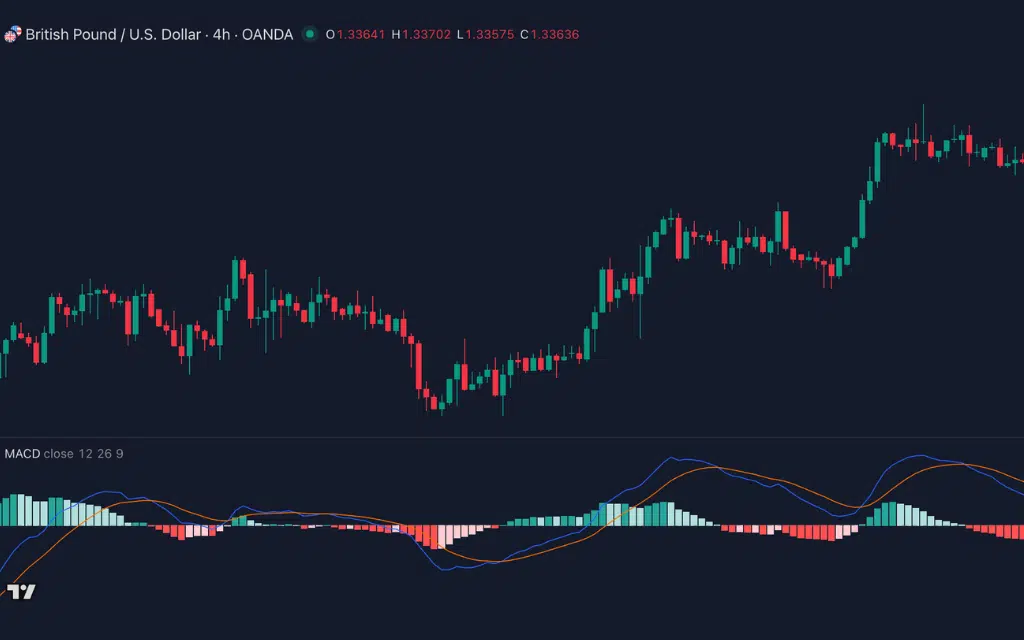
At its core, the MACD indicator measures two things at the same time: trend direction and momentum strength.
It does this by comparing two moving averages – a faster one and a slower one. When the faster average pulls away from the slower one, momentum is increasing. When it moves back toward it, momentum is fading.
That difference is plotted as the MACD line. A signal line is added to smooth things out and a histogram visually shows whether momentum is accelerating or slowing down.
That’s it. No complicated math. No secret formula.
That simple concept is the reason MACD has survived decades of market evolution, from stocks to Forex, and now crypto.
2. The Hidden Flaw Inside the MACD Indicator
Here’s the part most MACD indicator explanations leave out.
The problem with classic MACD isn’t the idea behind it.
It’s the lag.
Traditional MACD relies on standard moving averages. And by nature, those averages react after the price has already moved. That means MACD often confirms a trend only when a large part of the move is already over.
When traders notice this, they usually try to “fix” MACD by adjusting the settings:
- Make MACD faster → signals appear earlier, but noise increases
- Make MACD slower → signals look cleaner, but entries come late
This creates an impossible trade-off. No matter how much you tweak the inputs, the core issue remains: classic MACD reacts too slowly to modern market conditions.
That’s why traders experience the same frustration again and again:
- Entering after momentum is already exhausted
- Exiting only after profits shrink
- Watching price move first… and MACD confirm later
The flaw isn’t you.
It’s the way traditional MACD is built.
A complete MACD indicator explanation must address this lag – not ignore it. And that’s when it became clear something had to change.
3. A Modern Upgrade To The Classic MACD Indicator
The Master MACD indicator was designed to solve one problem:
How do you keep the proven logic of MACD, but make it respond faster, without adding noise?
The solution was surprisingly straightforward.
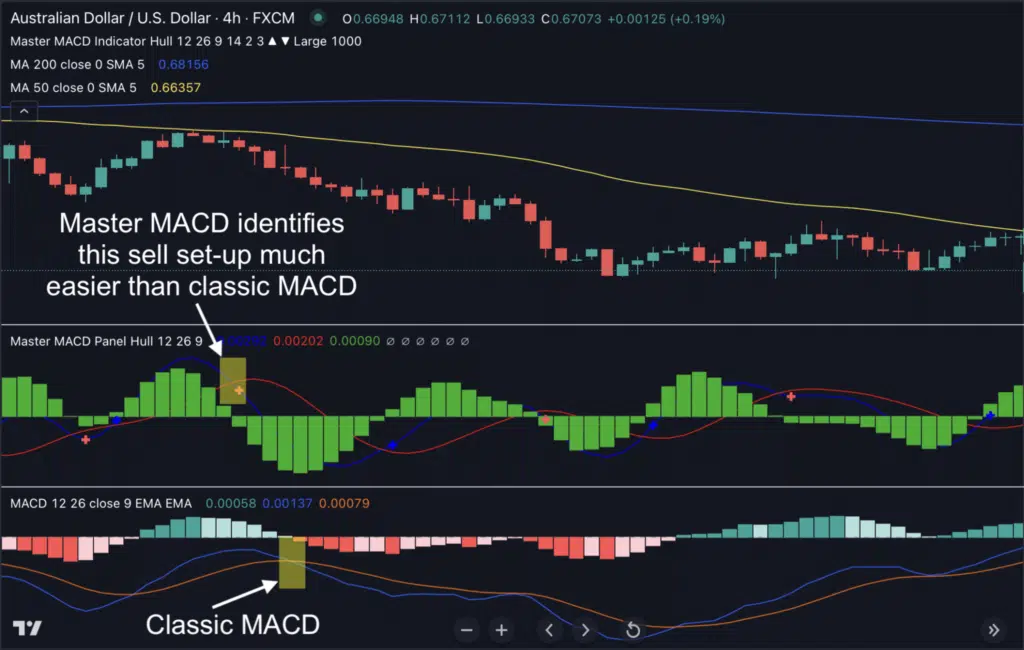
Instead of relying on slow, traditional moving averages, Master MACD uses faster, more adaptive moving average types, including the Hull Moving Average. This allows the indicator to react more quickly to changes in momentum while remaining smooth and readable.
What does that mean in practice?
- Signals appear earlier than classic MACD
- Momentum shifts are detected faster
- Trends, breakouts, and reversals become clearer
On top of that, Master MACD adds features that traders actually need, but classic MACD never had:
- Clear visual arrows on the chart
- Pop-up and audio alerts for every signal
- Cleaner structure that removes guesswork
4. How To Use The Master MACD Indicator
One of the biggest advantages of Master MACD is flexibility, without complexity.
4.1 Master MACD Settings Explained Simply
With Master MACD, you can choose the moving average type that fits your trading style:
- Simple Moving Average (SMA)
- Exponential Moving Average (EMA)
- Linear Weighted Moving Average (LWMA)
- Hull Moving Average (HMA)
This allows you to control how responsive the indicator is without endlessly tweaking numbers.
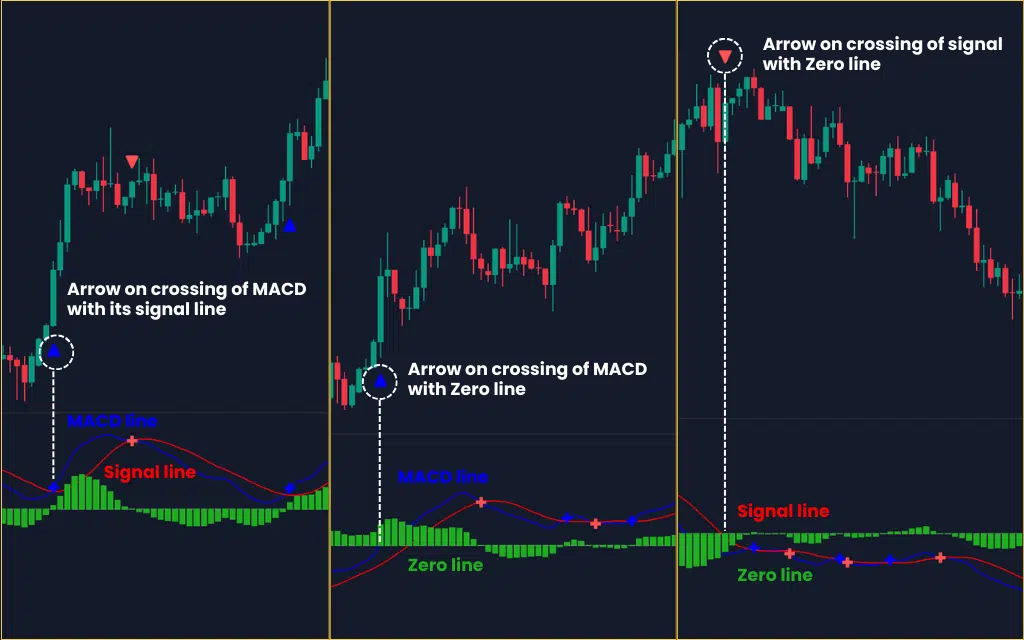
You can also decide exactly which crossover events trigger alerts, such as:
- MACD line crossing the signal line
- MACD crossing the zero line
- Signal line crossing the zero line
This way, you only get alerts that match your personal strategy, not constant noise.
4.2 Using Master MACD For Trend Trading
A simple and effective way to use Master MACD is for trend trading.
First, identify the overall trend using the 50-period and 200-period moving averages. If the 50 is above the 200, you’re in an uptrend. If it’s below, you’re in a downtrend.
Once the trend is clear, use Master MACD as the entry trigger.
Because Master MACD reacts faster than classic MACD, entries happen earlier in the trend, improving risk-reward and reducing late trades.
4.3 Using Master MACD For Breakouts And Reversals
Master MACD is also powerful for breakouts.
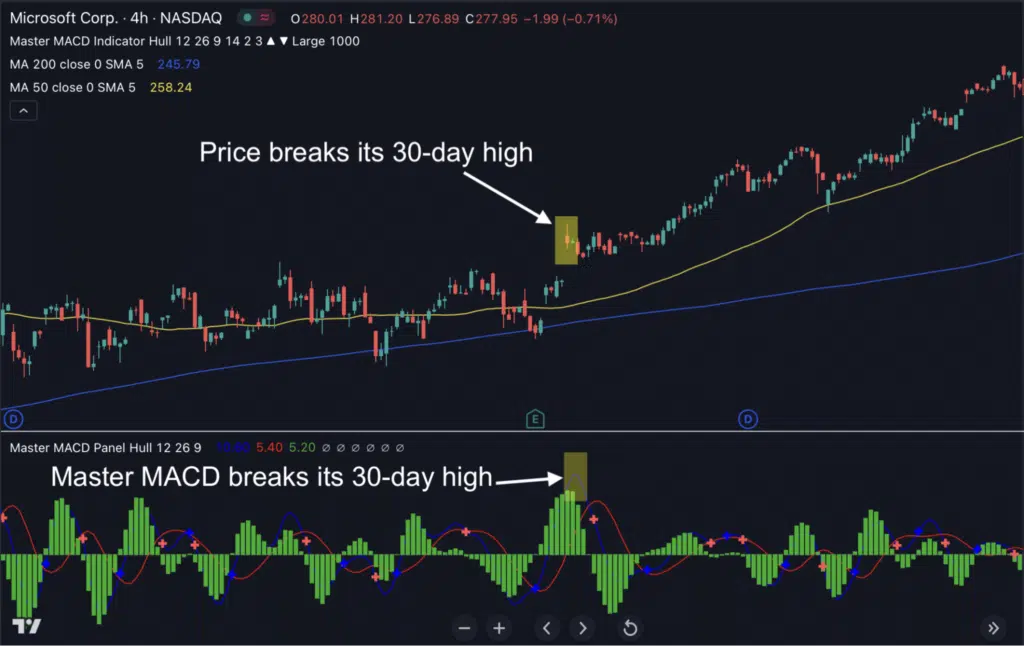
When price breaks a recent high or low and Master MACD confirms with its own momentum breakout, the move has a much higher chance of follow-through.
For reversals, Master MACD detects divergence earlier than classic MACD, giving you advance warning before momentum fully shifts.
5. Final Thoughts
There’s a reason MACD has stood the test of time. The logic is sound. The concept works.
But markets have changed.
Master MACD keeps everything that made MACD powerful, and removes what made it slow. It’s faster. Less lagging. Built for modern trading.
If you’re serious about trading momentum instead of chasing it, it’s time to upgrade. Click here to upgrade to Master MACD indicator for TradingView.