
Trendline trading remains one of the most trusted methods in technical analysis. When markets trend, price rarely moves in a straight line. Instead, it advances and pulls back in a structured way, and trendlines help traders visualize that structure.
When trendlines are expanded into trading channels, they become even more powerful. Channels provide both direction and boundaries, helping traders identify high-probability entries, exits and risk zones.
In this guide, we’ll explore how trendline trading works through trading channels, discuss proven techniques professionals use, and explain how modern tools can help traders apply channels more consistently.
Table of Contents
1. Understanding trendline trading
Trendline trading is based on identifying the direction of price by connecting swing points on a chart. A trendline is drawn by linking at least two significant highs or lows, showing whether the market is trending upward, downward, or moving sideways.
At its core, trendline trading allows traders to clearly define market bias, stay aligned with the dominant trend, and anticipate areas where price is likely to react.
However, relying on a single trendline can still leave uncertainty about where momentum may slow or a reversal could occur. This is exactly where trading channels enhance trendline trading by adding structure and context to price movement.
2. Trading Channels: The structure behind trendline trading
A trading channel is formed by drawing two parallel trendlines:
- The lower boundary acts as dynamic support
- The upper boundary acts as dynamic resistance
Price tends to oscillate within these boundaries, creating a rhythm that traders can anticipate.
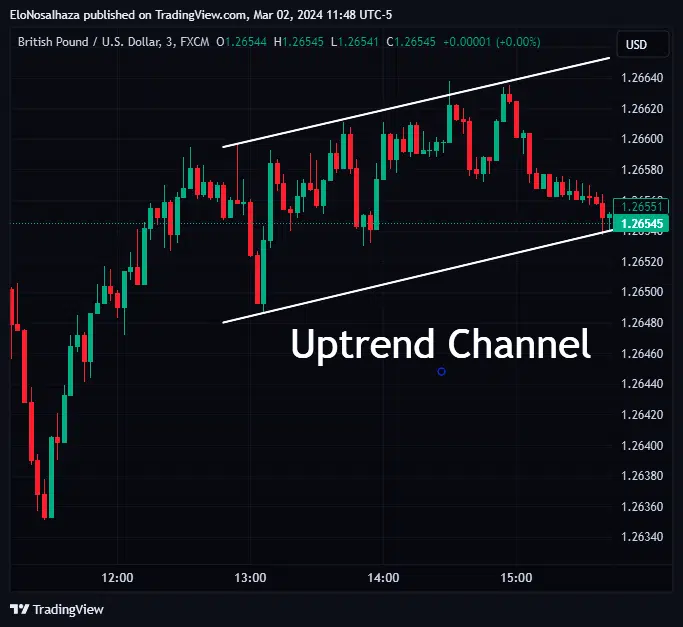
2.1 Uptrend Channels
Uptrend channels form in bullish market conditions, where price consistently creates higher highs and higher lows. This structure reflects strong buying pressure and a clear upward bias. Within an uptrend channel, traders typically look for buying opportunities near the lower boundary (channel support), expecting price to continue moving higher as long as the trend remains intact.
2.2 Downtrend Channels
Downtrend channels appear during bearish market conditions, characterized by a sequence of lower highs and lower lows. This price behavior signals sustained selling pressure and a downward market bias. In these conditions, traders focus on selling opportunities near the upper boundary (channel resistance), anticipating further downside movement as the trend persists.
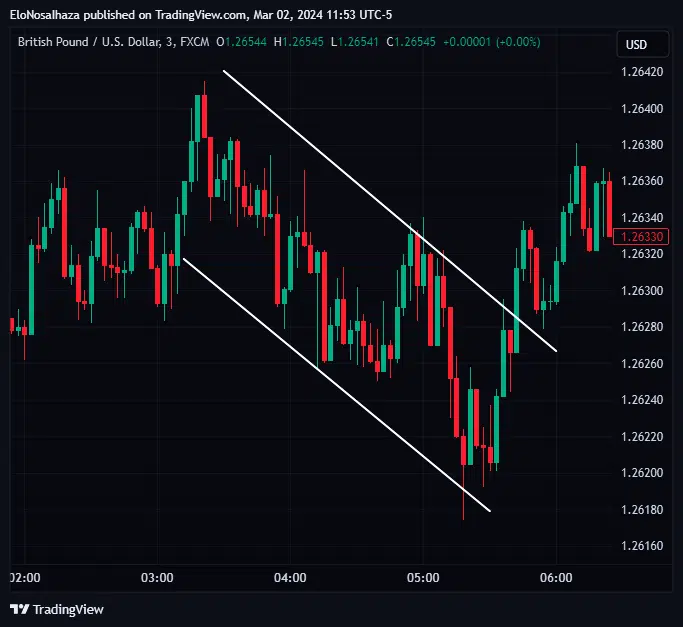
Trading channels are essential to trendline trading because they show not only direction, but also where price is likely to react, pause, or accelerate.
3. How traders use trading channels in trendline trading
Trading channels support multiple strategies, making them adaptable to different trading styles.
3.1. Channel bounce trading
Channel bounce trading is based on the expectation that price will respect the channel boundaries.
In an uptrend, traders look for buying opportunities near channel support, while in a downtrend, they focus on selling near channel resistance.
This strategy works best when the trend is stable and well-defined, as price tends to oscillate predictably between the channel limits.
3.2. Channel breakout trading
Channel breakout trading comes into play when price breaks strongly above or below the channel. Such movements often indicate increasing momentum and may signal trend acceleration or even a potential trend reversal.
Breakout traders typically wait for strong confirmation before entering, as false breakouts are common in choppy or low-volatility conditions.
3.3. Breakout-retest strategy
The breakout-retest strategy adds an extra layer of confirmation to channel breakouts. Instead of entering immediately after the break, traders wait for price to break the channel, retest the broken boundary, and then continue moving in the breakout direction.
This approach helps filter out false signals and significantly improves trade quality and risk control.
4. Four proven techniques for effective trendline trading
While trading channels are versatile, success depends on execution. These techniques help traders apply trendline trading with discipline.
4.1 Choose one trendline trading approach
Trading channels allow for reversals, breakouts, and trend continuation. The problem arises when traders mix strategies mid-trade, often driven by emotion rather than logic.
Professional traders avoid this by deciding on a single approach before entering a position and ignoring signals that do not align with their strategy.
In trendline trading, consistency matters far more than flexibility, as sticking to one clear strategy leads to more controlled and repeatable results.
4.2 Stay cautions during high-impact market events
High-impact economic news often causes sharp price movements that can temporarily break trading channels and distort market structure.
During these periods, false breakouts become more frequent, and channel boundaries may lose their reliability. Experienced trendline traders adapt by reducing position size or waiting until price action stabilizes and structure is clearly re-established before taking new trades.
This cautious approach helps protect capital during unpredictable market conditions.

4.3 Confirm trading channels across multiple timeframes
Using multiple timeframes significantly improves the accuracy of trendline trading. A breakout on a 5-minute chart may appear significant, but if price still respects a channel on the 1-hour or 4-hour timeframe, the breakout may lack follow-through.
To avoid false signals, traders first identify the primary trading channel on higher timeframes, then look for entries on lower timeframes in the same direction. This alignment filters out market noise and increases confidence in each trade.
4.4 Apply strong risk management
No trendline or trading channel remains effective indefinitely, which makes risk management essential. Professional traders protect their capital by placing stop-loss orders beyond channel boundaries, using proper position sizing, and locking in partial profits as price moves within the channel. While trendline trading rewards patience and discipline, consistent profitability is only possible when risk is carefully controlled.
5. Using Linear Regression Channel indicator for advanced trendline trading
Manual drawing trading channels requires experience and constant adjustment. Minor differences in swing selection can lead to very different channel structures.
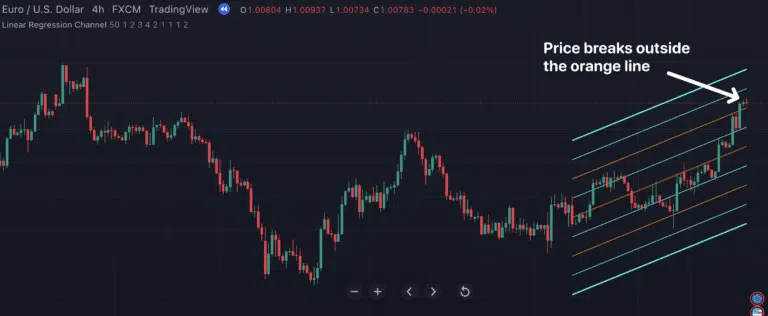
The Linear Regression Channel indicator for TradingView addresses this issue by applying statistical methods to price data. Instead of subjective line drawing, the indicator:
- Identifies the most probable price path
- Measures trend strength and slope
- Defines channel boundaries objectively
This allows traders to focus on execution, not redrawing lines.
In short, below are some of the most thrilling benefits every user enjoys from its application:
- Certainty of when channel trendlines are strong enough to keep the price within
- First-hand knowledge of possible channel breakouts below or above
- Guaranteed awareness of potential opportunities due to the tool’s responsiveness in real-time.
- Assurance of never missing setups, thanks to the prompt alerts from within and outside the platform
Unbelievable? Click here to be stunned by the impressive results today.
6. Final thoughts
Trendline trading remains a cornerstone of technical analysis because markets naturally move in structured trends. When enhanced with trading channels, trendlines offer clearer insight into price behavior, risk zones, and opportunity areas.
Whether you trade reversals within a channel or breakouts beyond it, mastering channel structure can significantly improve consistency.
For traders seeking a more objective approach, tools like the Linear Regression Channel help bridge the gap between theory and real-world execution, allowing trendline trading to be applied with greater clarity and confidence.