
Easy Wolfe Wave: How to use wolfe wave patterns to catch the perfect entry





Learn how to trade Wolfe Waves without the manual drawing headache. Discover the geometric sweet spot that predicts reversals and how to let Easy Wolfe Wave do the math for you.
Most traders struggle because they treat the market like a series of random events. But what if you could see the invisible structure behind price reversals?
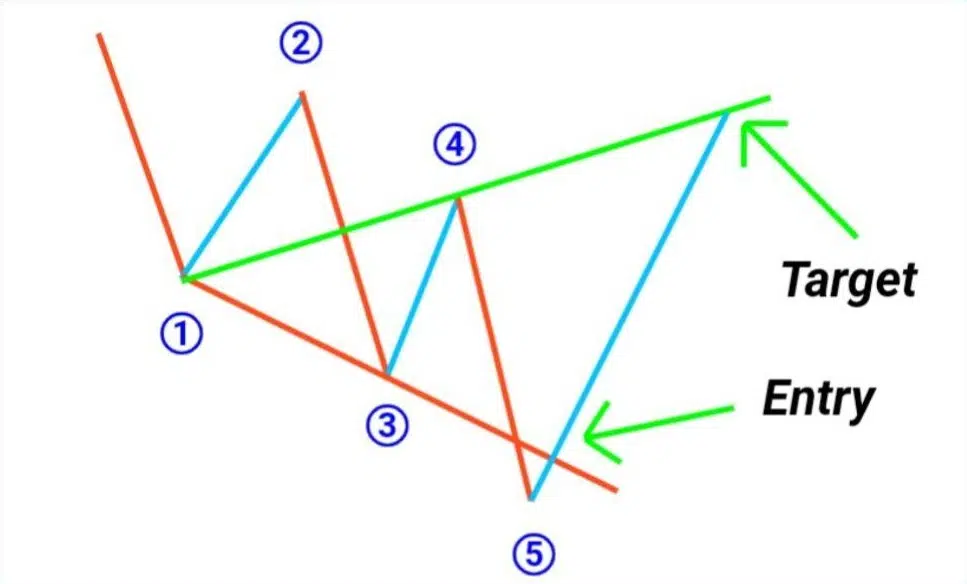
The Wolfe Wave is one of the most reliable chart patterns for spotting trend exhaustion. It’s based on a specific five-point struggle between buyers and sellers that creates a predictive geometric path for price.
A valid Wolfe Wave must meet specific geometric criteria to be considered tradable. It consists of five points that form a narrowing wedge:
To trade this successfully, you need more than just a pattern; you need a system.
Most beginners jump in the second price touches the 1-3 trendline at Point 5. Professionals wait for reversal price action. Look for:
Wolfe Waves have a time component called the ETA (Estimated Time of Arrival). If you draw a line connecting Point 1-3 and another connecting Point 2-4, the place where they intersect horizontally often predicts when the price will hit the EPA target.
Not every wedge is a Wolfe Wave. For a high-probability trade:
Let’s be real: spotting these five-point moves in real-time is a headache. By the time you’ve manually drawn your lines, the move is often halfway over. That’s why we built Easy Wolfe Wave for TradingView, to take the manual labor out of the equation so you can focus on the trade, not the drawing tools.
The manual method of drawing these waves is prone to human error and wishful thinking. You might draw a wave just because you want to take a trade.
Easy Wolfe Wave for TradingView removes the bias:
While the pattern is strong on its own, the pro way to trade it is by layering it with other tools. Here are two strategies to maximize your edge:
While the pattern is a beast on its own, adding confluence is how you separate the amateurs from the pros.
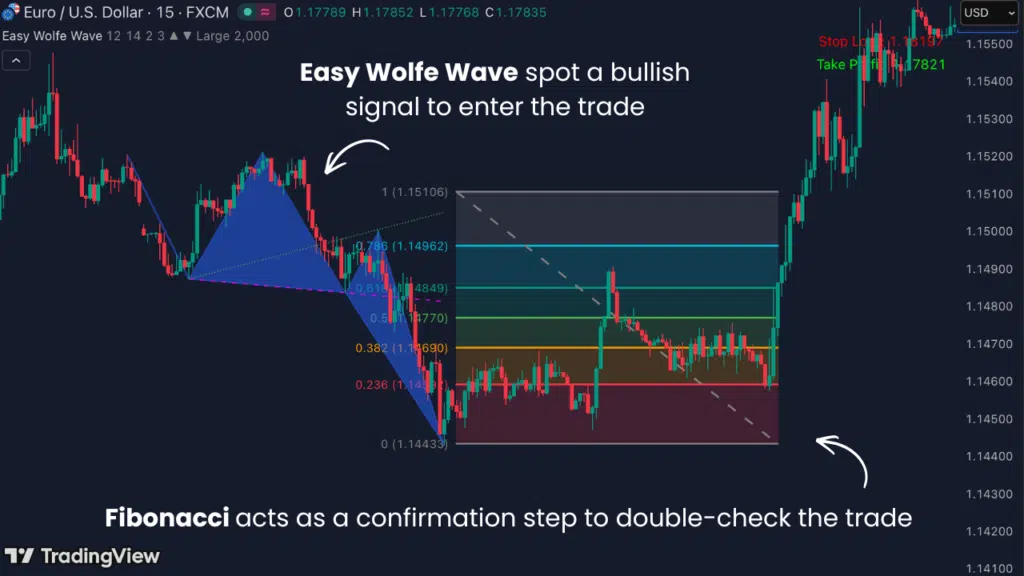
Take this EUR/USD 15-minute chart example. By using the Easy Wolfe Wave indicator to identify the structure and layering on Fibonacci Extensions, you get a precise map of where the reversal is likely to happen.
On this chart, price tanked through the 1.148 extension and reacted sensitively to the third standard deviation before snapping back. When the geometry of the Wolfe Wave aligns with these hidden Fib levels, your confidence in the trade doubles
If you want to maximize your profit, you can’t just trade the pattern, you have to trade the structure. Look at this GBP/AUD 3-hour chart for the ultimate SMC setup.
Once the indicator identifies a bullish bias, we don’t just jump in. We look for a break of structure (BOS):
Watch the video below to see how the indicator identifies the setup before the price even reaches the entry zone. You’ll see how to layer it with Fibonacci and Supply/Demand levels for maximum precision.
The Wolfe Wave is a window into the natural rhythm of the market. It gives you a clear entry, a safe stop-loss, and a math-based target.
However, the difficulty has always been the manual execution. Human error, subjective drawing, and the time required to scan multiple charts often lead to missed opportunities or, worse, bad entries.
Easy Wolfe Wave for TradingView changes the game.
If you’re tired of guessing where a trend might end and want to start trading with the confidence of market geometry, it’s time to add the Easy Wolfe Wave to your toolkit.
Moving averages are essential for identifying market trends, but traditional indicators lag and create false signals. Discover how the Trend Focus indicator filters our noise, spots real trend direction, and helps you trade with precision. 1. What is the moving average? The moving average is one of the most widely used tools in technical analysis….

Introducing the Scientific Scalper indicator for TradingView You enter a trade, only to watch the market reverse seconds later. You skip the next one — and that’s the one that runs. It’s easy to fall into the trap of chasing moves, reacting instead of anticipating, and letting uncertainty take over, all due to not having…
Have you ever looked at a trading chart, using your trusty RSI, but felt like you were always a step behind, or overwhelmed by confusing signals that just led to missed opportunities? You’re not alone. Manually identifying genuine turning points and differentiating between real signals and noise with traditional RSI can be incredibly difficult and…
Table of Contents 1. What Is A Candlestick Pattern? A candlestick pattern is a visual representation of price movements over a specific period, helping traders understand market sentiment. Each candlestick contains four key pieces of information: open, close, high, and low prices within a given timeframe. Traders use these patterns to predict future price movements,…
Table of Contents 1. The Core Distinction: Reversal vs. Retracement A Price Retracement is a temporary, short-term counter-move against the prevailing trend. It’s considered a healthy pullback that allows the market to cool off before resuming its primary direction. A Price Reversal is a sustained, fundamental change where the dominant market force shifts, causing a…
Trading bearish candlestick patterns can be a way to potentially profit from a downtrend in the market. Table of Contents 1. What are Bearish candlestick patterns? Trading professionals use candlestick patterns, a type of technical analysis, to analyze price changes in financial assets like stocks, currencies, commodities, and bonds. A series of candlesticks with a…